October 3, 2014

3rd Continental Dragoons

Here are the 3rd Continental Dragoons...


For games that call for regimental sized units (I may end up using the new Horse and Musket rules Barry and I are working on), I can brigade the squadrons together for a unit with more staying power on the table...


Lots of infantry on the way...

October 1, 2014

1st Continental Dragoons

October is going to be AWI month! I am going to try and add a little to the American army EVERY day, though I won't always have time to post every day.

To give me a head start on the blog, I have a couple of cavalry squadrons already finished to start things off...


My plan called for THREE stands of the 1st and 3rd Dragoons combines, but as most rules I use have squadrons of six models, I figured I might as well go ahead and paint six models of each regiment. Accounts of the uniforms of the 1st Continental Dragoons have them in either blue coats with red cuffs or brown coats with green cuffs (and Troiani has depicted them in blue coats with green cuffs). They seem to have worn both and there is confusion as to when they changed, so I simply decided to mix them together (which is probably how they made the transition anyway).

I'll post the 3rd Continental Dragoons in a couple of days...

September 21, 2014

The Plan: Americans for the Battle of Cowpens

I have written before that A Devil of Whipping is the book that gave me the push to finally collect models for an American war. For the most part he Battle of Cowpens was the perfect size to be manageable in 28mm at 1:10. The amount of cavalry at the battle is overkill for most of the period, but by mounting the models on single bases, I can use them in skirmish games - a role for which they would have been far more common -  so the effort is not wasted. I used Greg Novak's The American War of Independence, Book Two, The Southern Campaigns to rough out the models I would need. Please note that I am not really intent on replaying this battle, but merely interested in collecting initial forces that are similar.

The goal for my American army:

C-in-C (Brigadier General Daniel Morgan)
Two Brigade Commanders (Colonel Andrew Pickens and Lt Colonel William Washington)
One battalion of Maryland/Delaware Continental Infantry (6 stands)
One battalion of Virginian Militia Infantry (4 stands)
Three battalions of South Carolinian Militia Infantry (4 stands each)
One battalion of North Carolinian Militia Infantry (4 stands)
Skirmishers (14 models based singly, mixed uniformed and militia)
1st and 3rd Light Dragoons (3 stands)
VA/NC State Light Dragoons (1 stand, brigade with dragoons above)
Various Militia Light Horse (2 stands)

Now, I am already quite far along with what I need for this collection (and already have all of the models)...


I only need two more militia units, twelve cavalry, and a handful of skirmishers. Looking at my list, I actually want to expand the Continentals to eight stands to make two four-stand units (and maybe make three units... I think I have enough models on hand), push the cavalry to two stands for the 1st dragoons, two stands for the 3rd dragoons, and two stands for the VA/NC state dragoons, round out the skirmishers to 24 models, and add a couple of field guns and limbers.

Anyway, expect lots of AWI stuff over the next couple of months!

August 30, 2014

Yet More AWI Flags

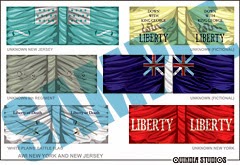
Ok... eight more American sheets for the AWI...

1. The Carolinas

2. Virginia

3. Maryland and Delaware

4. New Hampshire

5. New England and Massachusetts

6. New York and New Jersey

7. Connecticut

8. Pennsylvania and Rhode Island

There are four categories:
1. Known Regiments - these are famous... Green Mountain Boys, 7th Pennsylvania, etc. Ironically these are often famous because they were captured!
2. Known State Flags - these are documented for specific states, but the regiment is unknown.
3. Known Flags - these are known designs, but unknown regiments - they may have been either Continental or militia flags. When present, they may be used for any state, not just the sheet the on!
4. Fictional - Completely made up following conventions of the period... obviously these may be used for any unknown unit.

There were hundreds of flags and most are simply unknown. Some designs (or possibly the same actual flag) seem to have been carried by more than one unit, further complicating the issue. These sheets cover many of the known flags and should provide plenty of continental and militia flags for unknown units. If they prove popular, or we get specific requests, I will add more...

Of course you will soon be able to find these in the LoA shop.

August 27, 2014

More AWI - Mounted Militia

A quick addition for my rebels... mounted militia.


I decided to base these models singly. Most AWI battles have very little cavalry so it won't be too much of a chore to move the unit. I don't even see the need to bother with a movement tray. Where mounted models were more common would be the innumerable skirmishes that took place between battles, making these perfect for 1:1 games of, say... Donnybrook?


The weird thing is that I picked the Battle of Cowpens on which to base my initial collection, probably the only battle where a cavalry charge made a difference in the outcome. There was also a disproportionate number of mounted troops compared to most AWI battles, meaning my collection will have many more models than I need... unless playing a 1:1 skirmish game (see how cunning I am)!

At Cowpens, there seem to have been around 180 American horse and nearly 300 British (well, technically more Americans since most were British Legion with a few 17th Light Dragoons). I plan to paint 18 American horse (12 Continental and State Dragoons and 6 Militia) and 30 British horse (24 British Legion and 6 17th Light Dragoons). Along with the singly based skirmish infantry I have planned for both sides, I should have plenty of models for fighting skirmish games.

I hope to have the next squadron up in a few days... the 1st Continental Dragoons.

August 23, 2014

Sons of Liberty

Today I managed to finish a unit that has been on my desk FOR A YEAR! This is extremely unlike me - I normally paint four or five models a day - but for now my free time continues to be very limited. This five stand battalion adds to my AWI collection...


The unit is meant to represent the Maryland/Delaware/Virginia formation at the Battle of Cowpens, so I mixed in several different coat/vest/trouser combos. Units were reorganized mercilessly between almost every battle in the southern campaign so I imagine very few units would present a uniform appearance.


Why five stands? That's all the uniformed models I had on hand, but upon finishing these models I was inspired and placed an order to give me enough models for seven additional stands. Nominally, I am shooting for a brigade of three four-stand battalions, but the half-hex command stand leading the unit means I can organize my units into battalions of two to six stands depending on the scenario (the same plan I used for my militia) - I just need to paint some more command stands! In addition, I already have several stands of mixed uniforms and civilian clothes from my militia that enables me to represent units of mixed troops and combine my Continentals and militia into units for even more flexibility...


... and yes, I know the stars and stripes probably weren't carried in the field, but this particular standard is known as the 'Cowpens Flag' and is rumored to have been carried at the battle. Besides, as I've said before, it's part of popular culture. Most people seeing the flag will recognize the period as the Revolutionary War. In any case, we don't know what flag (if any) they actually carried, so I'm fine with this one.


I have also managed a few cavalry for my patriots and I'll post those in a few days...

August 18, 2014

The Stars and Stripes

More American AWI flags are now available in the LoA store!

The flag most commonly associated with the Revolutionary War is the Betsy Ross Flag. Although this flag is commonly believed to have been created by Betsy Ross, the actual origins of the flag are unknown. According to legend, Betsy Ross was approached by General George Washington and George Ross, Betsy's uncle. However, Betsy Ross's role in designing the flag continues to be debated to this day. Regardless of who first created it, the Betsy Ross flag remains an icon of the American Revolution. It appears in numerous Revolutionary War-era depictions, even if historically inaccurate (as in Washington Crossing the Delaware).


It was also probably not carried by units in the field and served only rarely as an installation flag. However, it is iconic to the period and wargamers have been using it for years, so the first sheet features this flag in three different shading patterns (so you can field three without duplication).

The next set features three distinct variations. The Bennington flag is associated with the Battle of Bennington and presents yet another variant of the stars and stripes. It is differentiated not only by the unique pattern, but by an overlarge blue canton, and a reverse order of stripes (starts with white at the top). It was possible carried by a New Hampshire regiment. The second flag is the 'Cowpens' flag rumored to have been carried by the Maryland/Delaware battalion at that battle (later research claims this was not the case, but I'm going to use it on one of my continental battalions). The final flag combines the union jack symbol with the thirteen stripes and was believed to have been carried by several units (and maybe the ONLY reliable choice for  including the 1st Massachusetts and the 1st Canadian regiments.


The third features yet more variations. The first two were used by naval vessels and again by some installations. However, at least one drawing from 1779 shows one carried by an infantry formation (seen below the sample sheet over Clinton's Brigade).

This sheet also features the Guilford Courthouse flag, the name given to a North Carolina militia banner which was reported to have flown at the Battle of Guilford Courthouse. The flag is recognizable by the reverse colors normally seen on American flags: red and blue stripes in the field with eight-pointed blue stars on an elongated white canton.


There are many variations on this theme: different star patterns, stars with five, six, or eight points, etc. and again rarely carried in the field, but this is one that you can at least make an argument for.

August 15, 2014

Black Powder Rebellion!

Very rarely do I write reviews. I don't consider myself an expert on the periods for which I paint little men, nor do I think others particularly care what I think. However, the American War of Independence is one of my periods of concentration and this book seemed worth the effort.

I just got my copy of Rebellion! for Black Powder. The book was written by Stephen Jones and published, of course, by Warlord Games. To be honest, the main reason I pre-ordered the book was to get the exclusive American officer sculpted by Alan Perry (I don't mind recycling drummers and standard bearers, but I am a sucker for distinctive officer models). I have never played Black Powder, but I enjoy the spirit in which the game is written and presented.

While I have not read the book cover to cover, simply flipping through revealed the extensive use it will see. First of all, Rebellion! is crammed full of great color photos of Perry AWI models deployed on stunning terrain. I guess putting on the critic hat I would say that a few of the pics appear a bit fuzzy or out of focus and several more could have benefited from better lighting, but the majority are top quality. As someone who has published wargame books full of photos it is something to which I am sensitive, but none are so bad as to detract from the overall presentation. Most of the book is laid out in the standard two column format and is easy to read.

The Exclusive Mini
Rebellion! features a thorough summary of the conflict across the different theaters of the war, but my favorite part is the army guides. These are worth the price of the book on their own. They cover the armies of Britain (including Hessians and American Loyalists), America (broken into four separate regions), France, and the Native American Indians. Each section covers organization, the various arms (infantry, cavalry, etc.), and uniforms of the forces. There are charts to cover specific units where such details were known. As I mentioned, I haven't read everything yet, but I see very little on the flags of the period. Highbrow AWI gamers will no doubt be annoyed to see the stars and stripes waving proudly over some of the American units...

There are also several pages on the weapons and tactics of the period and capsule biographies of the most prominent commanders on each side.

Finally we come to the scenarios. There are nineteen battles from Bunker Hill to Gloucester Point. The introduction to this section outlines the special rules needed to give Black Powder the proper feel for the period. Each scenario is presented with historical background, orders of battle, maps and terrain, deployment, and objectives. These are great scenarios for any rule system, not just Black Powder (and even make great set ups for fictional games in many horse and musket periods, not just the AWI).

Rebellion! provides inspiration to fuel collectors, painters, and wargamers. There is a wealth of information in the book, as well as a bibliography for more reading. You can also read Stephen Jones' designer notes here.

In case you can't tell, I highly recommend this book to anyone with an interest in the American War of Independence. I'm off to pore over the uniform guides!