Showing posts with label Napoleonic. Show all posts

April 10, 2021

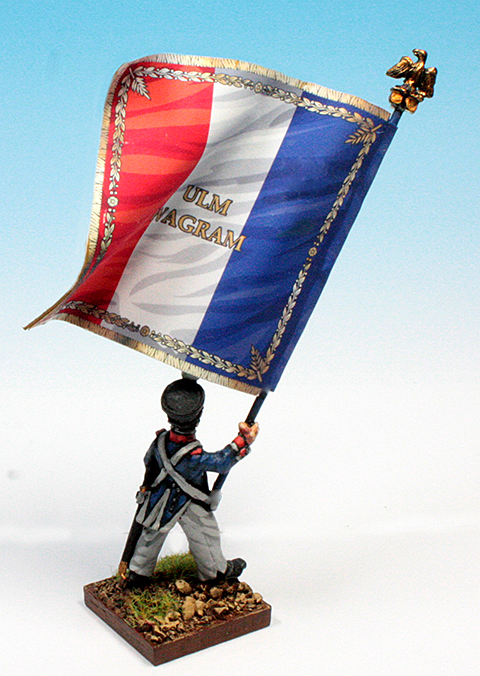
A Few New Flags for 1815


Napoleonics was my first love in wargaming before falling down the rabbit hole that led to the period of floppy hats and tricorns. While I've mostly concentrated on adding flags to the shops that can be carried proudly by Warfare Miniatures, I've had it in mind to expand to other periods. There's been a lull in Mad for War for the last few weeks while we've been going over the manuscript again in light of lessons learned knocking Mad for War Essentials into shape (don't worry, we're still on pace for late spring/early summer). It's not in my nature to be idle so I decided to wade into the future (of the BLB period, that is) and produce a few new flag sheets...


Well, ok... my OCD kicked in and I ended up with over 120 units - the entire French army for Waterloo (suitable, of course for any part of the 100 days campaign)! They are divided into divisions, which is how I normally set out collecting an army. Regiments were only issued one eagle in 1815 and this was carried by the first battalion. Opinions seem divide as to whether or not the infantry flags had fringe, but I decided to include it. If you fall into the camp of "without", it is easy enough to trim them off when you cut out the flag!

These will be available at Warfare Miniatures USA (in the US and Canada) and the League of Augsburg store (for the rest of the planet), though it may be a couple of days before they are posted...

Right! I'll have more flags for 1815 later this year. There are also a pile of naval flags (for both 28mm and 1/1200), WSS, and whatever I manage to find time for on the way!

July 20, 2010

The Battle of Almarez - Saturday

Last game and with a third variation on the set up. This time, Barry moved the village to the east end of the bridge and there were THREE fords, though two of them were hidden. The village was held by the 43rd Light Infantry while the 95th Rifles defended the obvious ford. The French actually missed one of the fords in the beginning of the game that might have spent doom for the French. A deserter had been captured before the game and placed adjacent to Marshal Ney, but though he was noticed, none of the French players thought to try and question him until turn five or six when the ford on the southern half of the table was revealed...


For the French, the 82nd and 50th line assaulted the village, supported a few turns later by the Legion du Midi and 2nd Westfalien. The remaining French infantry began inexorably to push the 95th back across the ford.


One of the innovative mechanics in Republic to Empire (and the upcoming 2nd edition of Beneath the Lily Banners) is the rules for Fighting in Built Up Areas (FIBUA). The rules fit seamlessly into the rest of the game, making it easy and fun to include farms, villages, forts, etc. - something I use to avoid in other rule sets. There are also rules for pioneers and engineers that give you the chance to model cool vignettes!


More pics from the action. The 95th was pressed back across the ford and formed into line. They managed to hold out for a couple of turns before being pushed back to the hermitage on the hill. The French captured the village, nearly wiping out the 43rd (who lost their colors in the process), but once again failed to capture the bridge and shelling from the RHA  and fire from the Spanish regiment forced them into retreat (The French commanders inadvertently tried to push their worst unit, the Legion du Midi across the bridge first). Despite the capture of the village, the game was a marginal victory for the British, denying the French both crossings.


However, a third crossing had been found and as with the other two games, had this battle been fought without the need to explain the rules or with the addition of a single hour, the outcome may have been much different as again the mounting pressure of the French was a turn or two away from making things very hot for the Allies!

Up next, a three part series of our Beneath the Lily Banners games...

July 17, 2010

The Battle of Almarez - Friday

For the next round of our Republic to Empire, Barry and I wanted to try something different. Though the terrain and goals were essentially the same (though the ford was moved), the starting positions of units were different. For one thing, each side had two squadrons of cavalry which failed to make it onto the board in the first game. Secondly, four companies (12 models) of the 60th Rifles were placed in the village and the French were told they needed to be rousted out in addition to capturing the bridge. One of the main reasons for this was to demo the Fighting in Built Up Areas (FIBUA) rules.There's a good pic of the village from this battle on Tyler's blog, as well as shots of some of the NPCs who got in on the action. Finally, one brigade of the 24th Light, the 2nd Westfalien, and the Legion du Midi entered near the northern edge of the table (near the bridge)...


The action started quickly. The 5th Hussars swarmed over the bridge, only to turn away from the combined firepower of the Spanish muskets and cannons. The 95th Rifles fell back as the cavalry turned toward them and the 2nd Westfalien splashed through a ford. Two battalions of the 66th line and two battalions of the Hanoverienne Legion close in on the bridge while the 26th Line, 82nd Line, and 50th Line assault the village.


The 5th Hussars were routed by the arrival of the KGL who successfully pulled up from their charge to avoid being disordered at the end of the bridge. The 66th formed up to charge the Spanish. Though it looks like the French infantry were in dire circumstances with the KGL on their flank, the cavalry were TOO CLOSE to mount an effective charge and their combat factors would be severely reduced in melee.


In the end, the first battalion of the 66th were routed as well. The French captured the village, but the bridge was still in dispute. I think we called this one a draw as the KGL were disordered in the face of the enemy, the French were in a good position to send three more battalions across the bridge, plus they still controlled the ford... if we could have played a few more turns, it may have been a French victory, however it may be interesting to note that Donkin's Brigade never arrived on the table, with the bulk of the fighting being done by the Spanish, KGL, and British Light Battalions. This shows with the proper scenario, you don't need to have huge armies to have a fun game. While the French had twelve or thirteen units, the British side only consisted of five infantry battalions, 1 cavalry regiment of 2 squadrons, and two half batteries of guns...

One more to go, with yet a different set up...

July 15, 2010

The Battle of Almarez - Thursday

This is the first of three posts to show some of the photos I took of our Napoleonic game. These aren't true 'after action reports' because I didn't have time during the games to keep accurate notes. We ran the game three times during the con, each time with the same objectives, but slightly different set ups to feature different aspects of the rules. We made minor changes to the orbats, in some cases fielding 'brigades' of two battalions to accommodate as many players as possible. Something to note for the 'this game is too complicated' crowd... we managed six or seven turns in three hours with four or five gamers per side who had never played the rules. Subtract from our time the 45 minutes taken for introductions, assigning commands, explanation of the command system, and other mechanics as they arose... experienced players could probably manage ten to twelve turns with division sized armies.

Thursday afternoon was our first game. The French started crowded in the south on the road from Almarez. The Spanish were deployed defending the bridge, with the Light Brigade marching onto the table behind them and Donkin's Brigade from the 3rd Division, supported by two guns of the RHA, moving up from the south on the west side of the river. Barry is the guy holding the scary playsheet which actually opens into a six-page screen - which by the way is the only thing we needed to run the game. The only thing I remember looking up in the book is the movement rate and command radius for generals...


Several turns in, each side has made good use of the Exploitation concept in the rules (which allows units multiple actions if enough Manoeuvre Points are available) and the battle is nearly joined...


The Hanoverienne Legion moves to capture the bridge with the 26th Line in close support. The 95th Rifles spread out on the west bank to slow them down while the two battalions of the Spanish Zaragoza regiment inches closer to the bridge.The Spanish units were much admired throughout the weekend and several people went in search of their own boxes of Victrix early French from the dealer stands to make their own conversions.


This is how our table looked for most of the convention...


The Hanoverienne were thrown back, though they rallied in good order and the 26th made the next attempt, but now the entire Light Brigade was formed up in defense. General D'Heroique led the charge and succeeded in routing one of the Spanish battalions, but was sadly killed in the melee. The 43rd and 52nd managed to stand, reform facing the enemy, and the 26th suffered mightily from short ranged volleys. In the distance, you can see the second French brigade massing to attempt to force a second crossing, a ford revealed by a French spy, though our three hour time limit had been reached so it was declared a victory for the British.


Everyone had a blast and several players were prompted to return to have another go on Friday. I'll post pics from that game in a day or two and after all of the Napoleonic pics are up, I'll show the three rounds from our award winning Beneath the Lily Banners game!

July 11, 2010

Time to Go Home

Tomorrow I'll be heading for home. At times the schedule we set for ourselves was very hectic, but it has been a fantastic trip! Barry Hilton and I won two awards for our 2010 Historicon games:

PELA GAMEMASTER AWARD 2010 and
HISTORICON BEST THEMED EVENT 2010


I'll be writing more about the event and my experience when I have time to do justice to the post, but for now here are two shots of the action, one from each game...


The first is the Battle of Almarez game I've been nattering on about on this blog and the second was our Grand Alliance Battle of the Boyne. I'm off to finish packing and then off to bed!

June 17, 2010

The Battle of Almarez, August 6th, 1809

The British won the battle of Talavera, but were forced to retreat all the same as French reinforcements arrived. The British formed a new defensive position behind the river Tagus. All of the crossings were well defended, but that might not have been the case if Marshal Soult had been more decisive. One crossing near the village of Almaraz was held initially only by a force of 1000 Spanish Line Infantry and a small detachment of guns. The bridge across the river is described as "broken" but it was apparently still passable by foot. There was also a ford nearby.

Historically, Wellesley had four days to prepare his defenses and he positioned General Craufurd and his Light Brigade to reinforce the Spanish. At this time, the Light Brigade consisted of the 43rd, the 52nd, and the 95th. He also attached Donkin's Brigade to Craufurd, though this brigade had suffered heavy casualties at Talavera, loosing around a third of it's strength (read 24-man battalions rather than 36). This brigade included the 87th (the Prince of Wales' Own Irish) and 88th (Connaught Rangers) line as well as a handful of the 60th (more riflemen, this time with red facings). Soult dispatched Marshal Ney (finally) to take the crossing, but Ney found it too well defended by the time he arrived.

But what if Soult had been more decisive or Ney was able to pull off one his famous night marches and the French could arrive before the British reinforcements? Say the allies start with only two Spanish battalions and a weak battery of guns on the board when Ney attacks with elements of the Sixth Corp. The British reinforcements would arrive during the game.


This is the scenario Barry and will be running for Historicon. The forces are listed below and have been modified both to meet my collection (the 75th and 45th substituted for the 87th, etc) and to provide enough units for a multi-player battle, though the organization may be modified depending on how many players and commands are needed...

Third Division, Craufurd

Light Brigade
43rd Light (30)
52nd Light (30)
95th Rifles (30)

Donkin's Brigade
88th Line (36)
74th Line (24)
45th Line (24)
60th Rifles (12 skirmishers)

Attached Cavalry
1st KGL (12)
RHA battery (2 guns)

Spanish Brigade
2 Battalions (24)
half battery of foot artillery

Loison's Division Command by Marshal Ney

First Brigade
26th Line (2 battalions, 36 each)
Legion Hannoverienne (2 battalions, 30 each)
Legion du Midi (24)

Second Brigade
32nd Light (24)
66th Line (2 battalions, 36 each)
82nd Line (30)

Attached Cavalry
5th Hussars (12)

Divisional Artillery
1 battery (4 guns)

The rough terrain board layout and is based on a map of the location that depicts the site of a raid on the same area in 1812. Fort Ragusa and the redoubt at the bridge would not have been there in 1809, but the structure on the hill south of the river would be there. The crown of Cerro del Tesoro (Treasure Hill) was the site of the Our Lady of Waters Hermitage. During 1808 and 1809, both the Spanish and French occupied the area and the hermitage was most likely destroyed during the fighting. The Spanish built a strongpoint on the hill in 1808 and the French expanded it into what became known as Fort Napoleon. The Spanish strongpoint can be the abbey I already own (R2E pages 63 and 69) and can be the site of the Spanish half battery (By the way, there is a complete step by step article on the construction process for this model in Battlegames 18).


The Tagus was quite a substantial obstacle during the Peninsular campaign - details from the 1812 raid mention a pontoon bridge 200 meters long (the object of the raid) which would work out to a little over 19 inches! I think in true wargame style, making the Tagus 10 to 12" wide would still look imposing without eating up too much table space. The ford was to the east of the bridge, but though it's existence was known by the French in 1809, it's location was not. The ford was four feet deep and apparently could not be spotted simply from the banks as Oman mentions French hussars failing to find it for several days. Again, depending on the number of players, the ford may be known at the beginning for game purposes so as many people as possible can get in on the action.

The Almaraz Bridge (known by locals as the Albalat Bridge)...


Historically, accounts say the bridge was destroyed by the Spanish, but apparently foot traffic was still possible (maybe by planks laid across the gap or maybe it was only missing a chunk that prohibited guns and baggage trains - not sure). Since I don't plan on making the bridge a permanent part of the river board, I can't copy the bridge exactly, but I can mimic the style of the arches, etc. I have also modeled the bridge with a chunk blown our of it and planks across the gap.

The village of Almaraz was several miles to the north and not really needed, but I modeled a few small cottages to stick in out the way spots for atmosphere. Again, the exact details will be modified on the fly to preserve game balance. I don't normally worry about having perfectly balanced forces, but the object of this game will be to introduce the rules to many people who have never played REPUBLIC TO EMPIRE and give as many people a chance to throw some dice as possible.

February 9, 2010

11 in 24

Charging on!


Barry has started a new feature in his gallery on the LoA site to illustrate unit types and sizes for playing games with REPUBLIC TO EMPIRE. Hopefully it will become a handy reference source for players building Napoleonic collections. His site will concentrate on the 100 Days Campaign and I may try to do something similar with my area of interest in the Peninsula.

February 8, 2010

6 in 24

I managed five models today! That is probably an unrealistic pace for the rest of the week. My normal goal is four models a day and to paint at least four days a week - the great coats tend to speed up the process so we'll see how it goes...

 
Damn! Speaking of great coats, I just realized I forgot the third highlight on guys wearing the gray coats! I generally don't bother with the third highlight on small items, like a rolled up great coat, so I skipped the third color! Well, I'll remedy that tomorrow in addition to anything else I get done.

February 7, 2010

1 in 24

Despite having a rare weekend off, I found myself ironically unable to get much accomplished!

 
I did manage a test figure which is my normal method of approaching a new unit and I'm very pleased with the way he turned out so it's full steam ahead! The painted model is a minor conversion (I love plastic minis). The base figure is one of the Perry skirmishers, but I removed the poor fellow's head to replace it so he's looking in the direction he's pointing rather than back at his troops as the original would be posed. The left arm is pirated from a spare Victrix sprue. I should be able to make a lot of progress this week and I'll try to post updates every night...

I also took the opportunity last night to mess around with the blog tool to come up with a layout more to my liking.

Plans are moving forward on the Historicon 2010 front. Barry and I had a very enjoyable phone call yesterday and hammered out a few more of the details. The plan is to run at least two games a day, split between Republic to Empire and Beneath the Lily Banners. To give as many people as possible the chance to join in, each player will control a brigade and we should be able to get six to eight people per game. It is my understanding that once the Historicon schedule is set you will be able to sign up for games in advance so keep an eye out if you plan to participate. I'll announce early sign ups here and more details as they unfold!

February 5, 2010

Legion du Midi

I finished another battalion of the Legion Hanoverienne and I'll post pics of the unit after I get it based, but it's time to start on another obscure unit that served with them in Spain... the Legion du Midi.

There were two units known by the name Legion du Midi. The first was formed of volunteers from Cette, Narbonne, Nimes and Perpignan on 27 April 1792. It served in the Vendee and existed for just over a year. The other was Franco-Italian and descended ffom the Legion Piemontaise which was raised on 18 May 1803 from the French departments of Italy. In the event only the 1er Legion Piemontaise was raised and in July 1804 it took the name Legion du Midi. It consisted of three battalions. The 1er and 2e were posted to the Caribbean where they were incorporated into the 82e de ligne in June 1805.

The 3e Bataillon, and the one we're concerned with, remained in France and was renamed 1er battalion. In 1807 it was posted to the 3rd Division of Junot's Army of Portugal, and served alongside the Legion Hanovrienne throughout its Peninsular service It remained in Spain and until August 1811 when it was disbanded and remaining personnel incorporated into the 11e and 31e legeres. 

I decided to use some Perry models for this unit, with the minor conversion and addition of a Victrix arm (the musket on a sling over his shoulder) for the grenadier on the end. The uniforms won't be as accurate since the Perry models are post 1812, but they will work fine for my table. The Legion du Midi wore brown coats with sky blue facings and were considered a light infantry unit, though their undistinguished service record doesn't suggest they were any more than drilled troops. They were, however, issued an eagle, unlike the Legion Hanoverienne (their standards are topped with simple spear points).

I'll be posting WIP pics of this unit every day I manage to accomplish something!

January 22, 2010

Vive L'Empereur!

Just a quick post to get a pic of a couple of my French battalions on the blog (and get 'French' listed in the sidebar). These are Foundry models and the flags are my own. This photo is one of many featured in REPUBLIC TO EMPIRE. For those unfamiliar with the rule set, you can see a preview of the book here.

January 17, 2010

Who?

After several questions on other sites where I posted the pic, I realized the Legion Hanoverienne was not a very well known unit!

The Legion Hanovrienne was created by General Mortier, Governor of Hanover, on 12 August 1803 following the French occupation. it was established as a regiment of light infantry in two battalions and a regiment of chasseurs a cheval in four squadrons. 

Desertion, sickness, and the consequences of campaigning in general, meant that neither the infantry nor cavalry elements ever realised their establishmeets. The Legion Hanovrienne was posted to the 3rd Division of Junot's Army of Portugal in 1807, where it served alongside the Legion du Midi (Which I will be adding to my collection next month). 

This Formation became the 3rd Division, VIII Corps, Army of Spain, later transferred to Soult's II Corps, where it became the 4th Division. The unit continued to serve with the Legion du Midi and both were joined in the 4th Division by the Detachement de marche of the Garde de Paris. By the beginning of 1810 the unit, still with the Legion du Midi, was in the 3rd Division of Ney's VI Corps. On 10 March 1810 the remains of the disbanded Bataillon de Westphalie, which had been combined with the Legion Hanovrienne in 1809, were used to form a second battalion.

Nevertheless, the effects of the war in Spain were such that the Legion Hanovrienne had to be disbanded on 11 August 1811. The remaining personnel were distributed amongst other German speaking regiments of the French army, 3e and 4e Etrangers, 127e, 128e and 129e de ligne. 

This information was pulled from an article by John Cook in the Age of Napoleon magazine, issue 21.

January 16, 2010

Legion Hanoverienne

My Peninsular French collection is based on Ney's VI Corps in 1810. There are several reasons I picked this corps - Ney is my favorite Marshal, the formation sparred with Craufurd's Light Division continuously that year culminating in the Combat on the Coa, and the presence of allied battalions to break up all of the blue coats!


This one of two Legion Hanoverienne battalions in Loison's Division made with Victrix models. The second one is under way as I post this. In addition I will be adding the Legion du Midi as well - basically French uniforms with brown jackets and sky blue facings. All of these units will be joining the French attack at Historicon!

January 11, 2010

No Army Lists? No Problem!

We made the decision early on to avoid trying to create points based lists for Republic to Empire. The period simply has too many armies and too many variations to do any kind of justice to such a project without devoting a whole book to it. Even then, I'm not confident that such lists would ensure fair and balanced games. I will agree that such lists are useful to the beginner, but I would argue it's just as easy to pick a real brigade to use as the focus for a collection. After all something brought all of us into the hobby, whether it was reading about a specific battle, a particular general or unit, or even a Sharpe novel! The Napoleonic period is well documented and there are detailed orders of battle for almost any battle you care to draw from.

Republic to Empire has a chapter devoted to the process of turning historical formations into tabletop armies, but let's look at one of my British Peninsular divisions for an example of how to do this.

The British Light Division is a wargamer's dream. Colorful personalities, elite troops, and a mix of coat colors (no having to paint six battalions with the same uniform). The composition of the Light Division changed nearly every battle (and indeed this is true with most formations in the period). For my collection, I chose the Combat on the Coa to serve as my model. Oman's History of the Peninsular War series is one of my favorite sources for detailed orders of battle for that theater. Although I couldn't find detailed unit strengths for the Coa, the third volume has Wellington's army listed at Bussaco which took place a couple of months later:

Light Division, Brigadier-General Craufurd

Beckwith's Brigade
      43rd Foot (804)
      95th Rifles (384, four companies)
      3rd Portuguese Cazadores (656)

Barclay's Brigade
      52nd Foot (946)
      95th Rifles (358, four companies)
      1st Portuguese Cazadores (546)

Republic to Empire is designed for a default 1:20 scale, but my collection was started years ago and is actually built on a 1:30 - no worries since you can field units of 18-48 infantry!

Beckwith's Brigade
      43rd Foot (27)
      95th Rifles (12)
      3rd Portuguese Cazadores (21)

Barclay's Brigade
      52nd Foot (31)
      95th Rifles (12)
      1st Portuguese Cazadores (18)

Finally, I base my units in stands of six models so I round my units to multiples of six:

Beckwith's Brigade
      43rd Foot (30)
      95th Rifles (12)
      3rd Portuguese Cazadores (24)

Barclay's Brigade
      52nd Foot (30)
      95th Rifles (12)
      1st Portuguese Cazadores (18)

That's it! This gives me a viable wargame force for small games that is colorful and historically accurate. At various times, the Light Division was detached on it's own and Craufurd was given a small cavalry element as well made up of the 1st KGL Hussars, 16th Light Dragoons, and a battery of RHA. Both cavalry regiments numbered around 450 in 1810 so I rounded down to two units of 12 models.


Veteran wargamers will not have learned much from this post, but it has been mainly aimed at the beginner who may be feeling lost without an army list. In a future post, I will talk about playing 'fair and balanced' games without using a point system.

January 8, 2010

More Rifles!

Part of my existing collection contains the Light Division and their most famous unit - the 95th Rifles!


As I mentioned before, I have plans to replace my existing collection with a combination of Victrix and Perry models. When I started collecting Napoleonics, Front Rank was the only manufacturer who made Cazadores that I liked.


The Light Division is a wargamer's dream:

1. An elite formation that saw action in almost every major Peninsular action (unlike collecting, say, the French elite Imperial Guard which probably shouldn't appear in great numbers on a wargame table unless you are playing really large games or very specific portions of a battle).
2. Lots of different coat colors! One of the soul destroying aspects of painting Napoleonics can be the endless drudgery of painting the same models over and over and over. The Light Division has red coated light infantry, brown coated Portuguese, and green jacketed riflemen!
3. It is a formation that was often detached on it's own in the Peninsula, making it appropriate even for very small games and skirmish level scenarios!

While I am very proud of my Light Division (only one brigade is shown above - I have both finished), the Front Rank models do not look good rebased with the rest of my collection. They are much larger than the Victrix I've used for the rest of my collection. They didn't look bad in the display case, but originally I based everything as single figures. I wanted to put the two light battalions on multi-figure stands and after trying to base the first unit, I found they looked terrible packed as close together as my Victrix units. The size difference was magnified as the models looked crowded. Thus I have made the decision to rebuild the Light Division with Victrix models (inclding the new metal Cazadores that will be out later this year). For Historicon, I only need Craufurd's original Light Brigade consisting of the 43rd, 52nd, and 95th. I MIGHT use my Front Rank 95th if I run out of time. They really are nice models and the size difference did not bother me until I tried to pack models onto 50x45mm bases.

January 6, 2010

The First Minis of 2010

I'm starting off the year with models I can use for both Historicon and my personal collection (clever, that).


When I set out to muster a new army for any period, I find an orbat from a battle that will form the basis of my collection. My initial foray into Peninsular Napoleonics for the British was Craufurd's famous Light Division. Having finished that (though I am now painting on building the division again using Victrix and Perry - more on that in coming months), I picked out Picton's Third Division to choose elements from next. I finished the first brigade (I'll post pics of them in the coming week) except for the 'penny packets' of the 60th Rifles that accompany the brigade. Eight of the twelve are pictured above and the other four are nearly finished...

January 2, 2010

Happy New Year!

2010 promises to be very busy. Besides a second edition of Beneath the Lily Banners and several scenario books for said rules, I will be focusing on Napoleonic painting for a participation game using Republic to Empire at Historicon 2010. More details on the project as it unfolds, but here's a peek at two of the units that will be involved...


These are Victrix French 1804-1807 painted as Spanish Line Infantry. While there are certainly differences in the uniforms, these work well enough for my table!

You'll probably see changes to this blog's appearance as we go along because I'm just getting into the tools available. Hopefully my regular site will see more updates too!